Some tournaments are remembered for a goal. Others for a moment. The 2026 FIFA World Cup will be remembered for scale.
Forty-eight national teams. Three host nations. Sixteen host cities. More than one hundred matches spread across North America. It will be the largest men’s World Cup ever staged, and it will redefine how football feels on a global stage.
For supporters travelling from Europe, South America, Africa, Asia or Oceania, the experience will stretch far beyond the ninety minutes on the pitch.
The 2026 World Cup marks the first expansion to 48 teams. According to official FIFA planning documentation, the new format will feature 12 groups followed by an expanded knockout stage beginning with a Round of 32. This structure allows broader global representation while maintaining competitive integrity.
It is also the first time the tournament has been jointly hosted by three nations: the United States, Canada and Mexico. Mexico will become the first country to host the men’s World Cup three times, while Canada steps onto the men’s World Cup stage for the first time.
Canadian football has evolved steadily over the past two decades. Hosting matches in 2026 cements that belief into a tangible legacy.
Toronto is not a ceremonial addition to the host list. It is Canada’s largest metropolitan region and one of North America’s most globally connected cities. The skyline reflects financial ambition. The streets reflect cultural diversity. On match days, the stadium reflects something far more emotional.
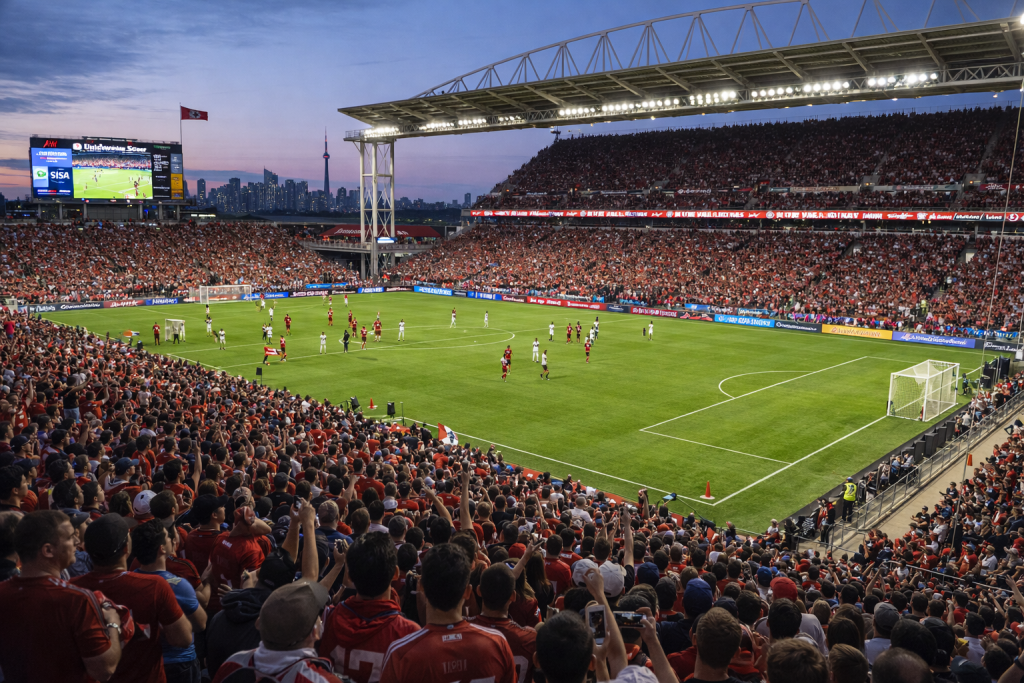
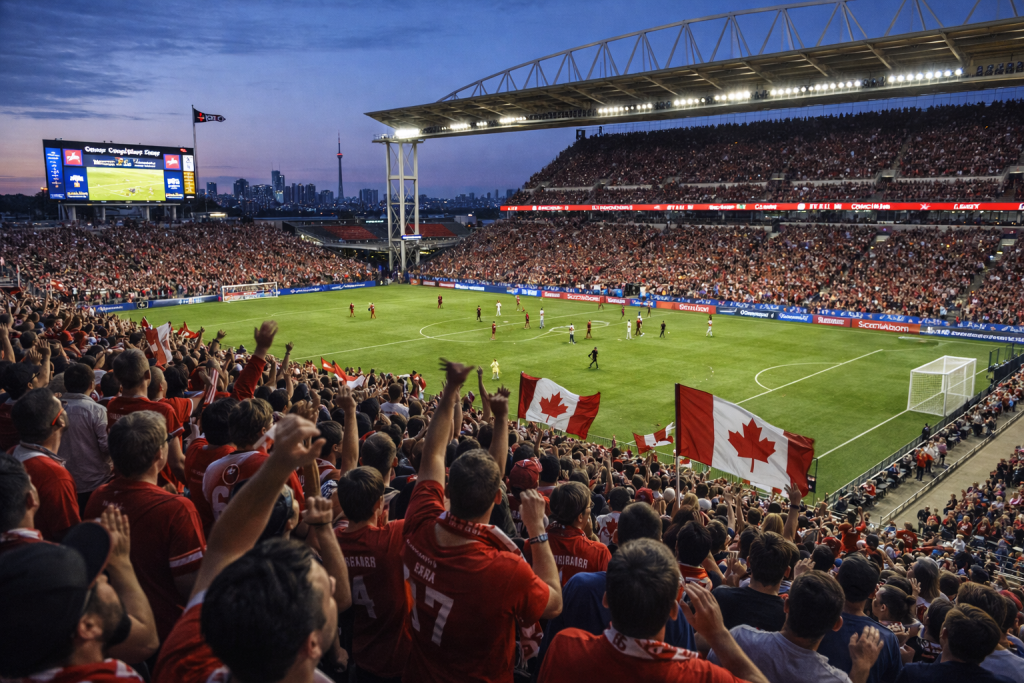
BMO Field, located at Exhibition Place near Lake Ontario, will host World Cup fixtures in 2026. Originally opened in 2007 and later expanded, it has served as home to Toronto FC and the Canadian national team. Renovations increased capacity and modernised facilities to meet international tournament requirements.
The stadium’s structure creates a compact, intense acoustic environment. Supporters sit close to the pitch. Sound does not drift. It gathers.
The 2026 World Cup marks the first expansion to 48 teams. According to official FIFA planning documentation, the new format will feature 12 groups followed by an expanded knockout stage beginning with a Round of 32. This structure allows broader global representation while maintaining competitive integrity.
It is also the first time the tournament has been jointly hosted by three nations: the United States, Canada and Mexico. Mexico will become the first country to host the men’s World Cup three times, while Canada steps onto the men’s World Cup stage for the first time.
Canadian football has evolved steadily over the past two decades. Hosting matches in 2026 cements that belief into a tangible legacy.